Who Could Replace Jensen Huang at Nvidia is now one of the biggest questions facing the technology industry following his reported resignation in November 2026. After 33 years leading Nvidia, the company’s next CEO will face the challenge of protecting its AI dominance, maintaining investor confidence, and continuing its semiconductor innovation.
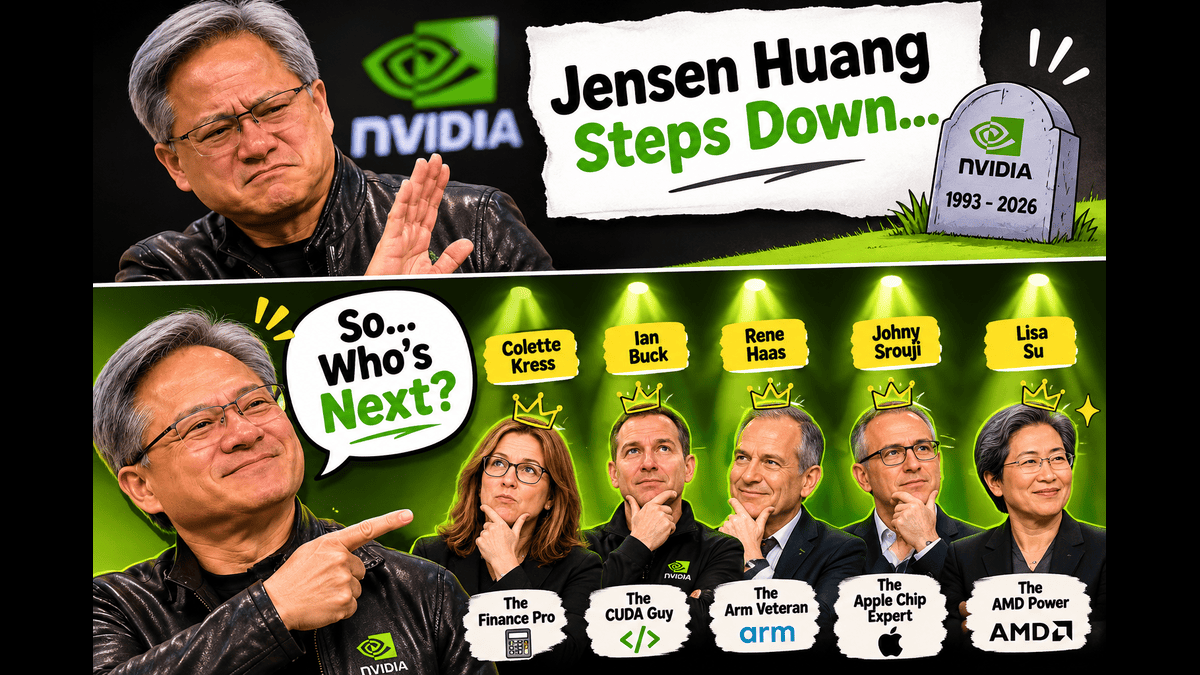
With CFO Colette Kress stepping in as interim CEO and the board searching for a permanent successor, five potential candidates are attracting attention: Colette Kress, Ian Buck, Rene Haas, Johny Srouji, and Lisa Su.
The question of who could replace Jensen Huang at Nvidia is becoming increasingly important for investors and the global semiconductor industry.
The question of who could replace Jensen Huang at Nvidia comes down to leadership experience, semiconductor expertise, AI innovation, and the ability to maintain Nvidia’s competitive advantage.
Table of Contents
Who Could Replace Jensen Huang at Nvidia? Top 5 Candidates
| Contender | Current Role | Type | Biggest Strength | Biggest Hurdle |
| Colette Kress | Interim CEO & CFO, Nvidia | Internal | Immediate stability & Wall Street trust | Lacks deep silicon/product engineering roots |
| Ian Buck | VP of Hyperscale & HPC, Nvidia | Internal | Co-creator of CUDA; owns the AI data center stack | No prior public-company C-suite experience |
| Rene Haas | CEO, Arm Holdings | External | Former Nvidia VP; proven semiconductor CEO | Leaving Arm mid-growth & potential regulatory scrutiny |
| Johny Srouji | Chief Hardware Officer, Apple | External | World-class custom silicon & supply-chain execution | Cultural shift from Apple’s closed ecosystem |
| Lisa Su | Chair & CEO, AMD | External | Turned AMD into a major AI rival; PhD engineer | Major antitrust hurdles & loyalty to AMD |
1. Colette Kress (Nvidia Interim CEO & CFO)
As Nvidia’s Chief Financial Officer since 2013—and now interim CEO—Colette Kress is already in the driver’s seat. Before joining Nvidia, she held senior finance leadership roles at Cisco, Microsoft, and Texas Instruments.
- Why she could win: Institutional investors already know and trust her from over a decade of quarterly earnings calls. She understands Nvidia’s hyperscaler contracts, supply-chain commitments, and capital allocation better than anyone else. If she stabilizes the stock through the November 17 earnings report and smooths over the board’s governance crisis, the “interim” tag could become permanent.
- The catch: Nvidia has always been an engineering-first company. Analysts question whether a finance-background CEO can set a 10-year architectural vision against aggressive custom silicon from Google, Amazon, and AMD.
Colette Kress and Ian Buck are particularly interesting candidates when discussing who could replace Jensen Huang at Nvidia from within the company.
2. Ian Buck (Nvidia VP of Hyperscale & HPC)
If Nvidia wants to keep its iconic engineering culture intact without looking outside, Ian Buck is the clear internal frontrunner. Having joined Nvidia in 2004 after earning his PhD at Stanford, Buck spearheaded the development of CUDA—the software moat that makes Nvidia’s GPUs nearly impossible for AI developers to abandon.
- Why he could win: Data center revenue now accounts for roughly 90% of Nvidia’s business, and Buck already oversees Nvidia’s hyperscale AI hardware and software products. Promoting him signals complete continuity for cloud providers and AI labs.
- The catch: Buck has never served as a public company CEO or CFO. The board may decide that Nvidia’s geopolitical and regulatory challenges require a seasoned chief executive rather than a first-time CEO.
For investors evaluating who could replace Jensen Huang at Nvidia, Ian Buck represents a potential continuation of the company’s engineering-first culture.
3. Rene Haas (CEO of Arm Holdings)
Rene Haas checks almost every box on paper. He currently serves as CEO of Arm Holdings—whose chip architecture powers billions of smartphones and data center CPUs—and previously spent seven years at Nvidia running its computing products business.
- Why he could win: Haas combines deep institutional knowledge of Nvidia’s internal culture with four years of proven experience leading a publicly traded semiconductor giant. He also maintains strong relationships across the global chip supply chain.
- The catch: Poaching the sitting CEO of Arm—especially after Nvidia’s failed attempt to acquire Arm years ago—would trigger intense scrutiny from regulators and major Arm licensees like Apple and Qualcomm.
When considering who could replace Jensen Huang at Nvidia, the board must evaluate technical leadership, business experience, and long-term AI strategy.
4. Johny Srouji (Apple Chief Hardware Officer)
Promoted to Apple’s Chief Hardware Officer earlier in 2026 after years as SVP of Hardware Technologies, Johny Srouji is the architect behind Apple Silicon (the M-series and A-series chips).
- Why he could win: Srouji is widely regarded as one of the sharpest silicon executives alive. Following Apple’s own leadership reshuffle earlier this year—when John Ternus stepped into the CEO role—industry watchers noted Srouji could be open to a top executive post elsewhere. His track record in custom chip design and TSMC manufacturing partnerships is unmatched.
- The catch: Srouji has spent nearly two decades operating inside Apple’s secretive, vertically integrated consumer hardware model, which differs sharply from Nvidia’s open enterprise developer ecosystem.
5. Lisa Su (Chair & CEO of AMD)
Any list of elite semiconductor leaders includes Lisa Su. Since becoming AMD’s CEO in 2014, Su engineered one of the greatest turnarounds in tech history, turning AMD into a formidable data center and AI accelerator competitor.
- Why she could win: Su holds an MIT PhD in electrical engineering, commands immense respect on Wall Street, and knows the AI GPU market inside out.
- The catch: This is widely viewed as a long shot. Beyond her deep commitment to AMD—where she also serves as Chair—moving directly from the CEO seat of Nvidia’s #1 GPU rival would invite immediate antitrust headaches and non-compete battles.
The Bottom Line: What Happens Next?
The final decision on who could replace Jensen Huang at Nvidia could shape the future of AI computing and the semiconductor industry for years to come.
If the Nvidia board prioritizes immediate calm and investor confidence, Colette Kress has the inside track. If they want a pure product visionary to protect Nvidia’s CUDA moat, Ian Buck is the natural internal heir. And if the board decides a clean break from the past requires an external heavyweight, Rene Haas offers the rare mix of Nvidia DNA and sitting-CEO experience.
Ultimately, who could replace Jensen Huang at Nvidia will depend on the board’s priorities and its vision for the company’s future.
Key Takeaways: Who Could Replace Jensen Huang at Nvidia
- The internal favourite is Colette Kress for stability, and Ian Buck for engineering depth.
- The strongest external name is Rene Haas, who knows Nvidia from the inside and already runs a major chip company.
- Johny Srouji and Lisa Su are credible but unlikely, because both are deeply tied to their current companies.
- The next CEO must protect Nvidia’s AI lead while keeping investors, customers and engineers confident.
- No appointment has been confirmed, so treat every name here as a candidate, not a decision.
What the Next Nvidia CEO Will Need to Get Right
Whoever is chosen to replace Jensen Huang at Nvidia will inherit a company at the centre of the AI boom. The new chief executive will need to keep Nvidia’s data-centre business growing, protect its relationships with cloud providers and chip manufacturers, and keep its software platform, CUDA, ahead of rivals. That is a demanding brief, and it explains why the board is weighing both insiders who know the culture and outsiders who have run large semiconductor businesses.
Leadership experience matters as much as technical knowledge. A finance-led interim chief can reassure investors, while an engineering-led chief can reassure product teams. The strongest candidate will need to do both. For context on the technology at stake, see our guide to what machine learning is and how it powers the AI workloads Nvidia’s chips are built for. You can also read Nvidia’s official leadership page for the company’s own view of its executive team.
Succession also matters for the wider industry. Nvidia’s choices influence how quickly AI tools reach businesses and what they cost to run, which is why this decision is being followed far beyond Silicon Valley. Our look at the future of automation in technology shows how those tools are already reshaping everyday work.
FAQ: Replacing Jensen Huang at Nvidia
Has Nvidia announced Jensen Huang’s replacement?
No permanent replacement has been announced. Colette Kress is serving as interim CEO while the board searches for a permanent successor, and the names in this article are candidates being discussed, not confirmed appointments.
Who is the most likely candidate to replace Jensen Huang at Nvidia?
There is no clear favourite. Colette Kress offers continuity and investor trust, Ian Buck offers deep engineering and data-centre experience, and Rene Haas offers a mix of Nvidia knowledge and proven semiconductor leadership. The board’s choice will depend on whether it prioritises stability, engineering, or an outside perspective.
Will a new CEO change Nvidia’s AI strategy?
A new chief executive is unlikely to abandon Nvidia’s AI focus, because data-centre and AI work is now the core of the business. The bigger questions are about pace and priorities: how fast to expand, which partnerships to deepen, and how much to invest in new chip designs. For a sense of the tools that depend on those chips, see our ranked list of the best AI tools for 2026.


Nice post