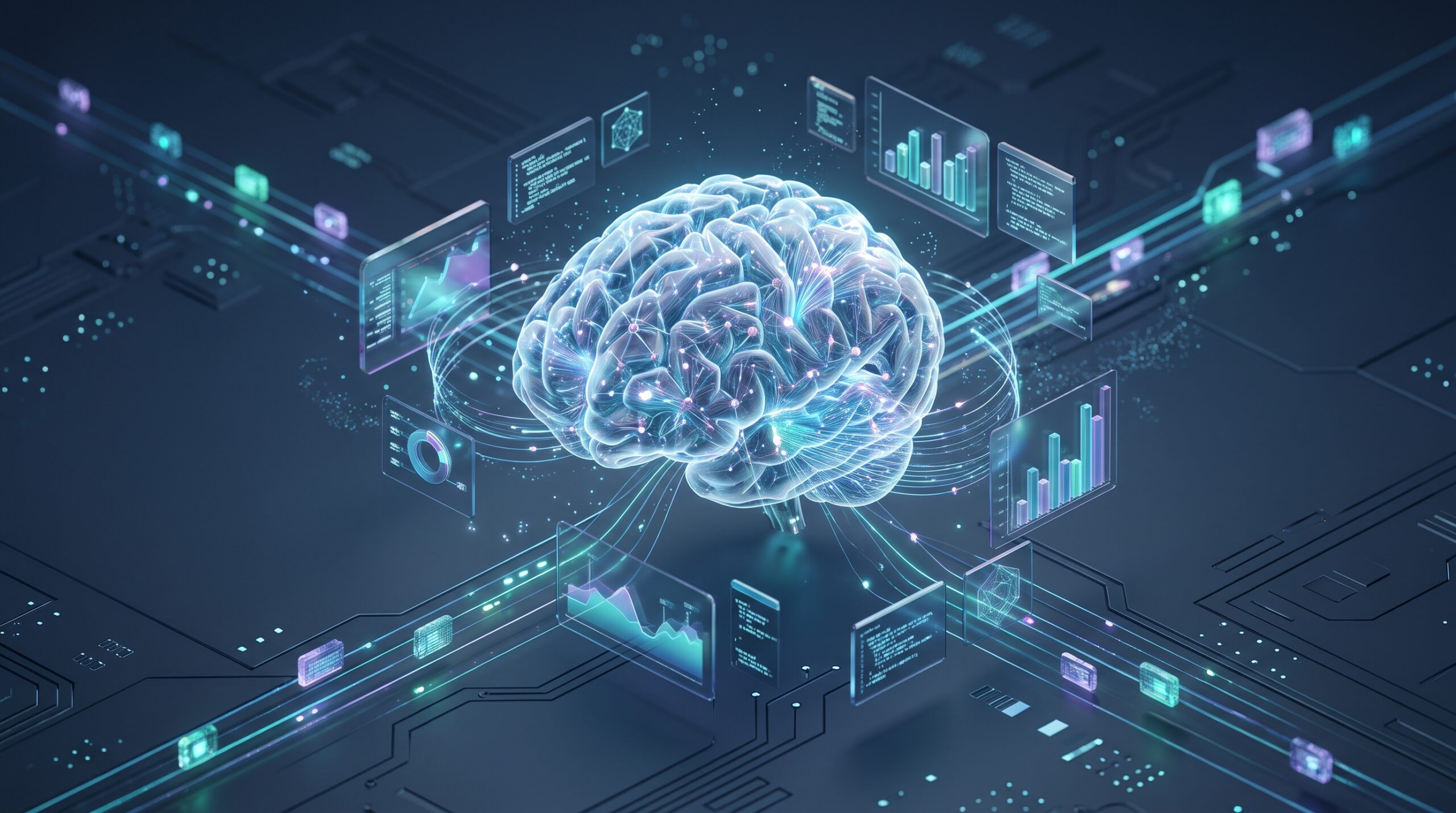
While modern AI feels brand new, the term machine learning was coined in 1959 by computer scientist Arthur Samuel at IBM, who built a checkers-playing program that got better the more games it played against itself. For decades, ML was held back by slow processors and limited digital data. Once cloud computing, modern GPUs, and massive internet datasets arrived, machine learning exploded into the engine powering almost every modern AI breakthrough.
Table of Contents
How Machine Learning Works: The 4-Step Pipeline
Once you grasp what is machine learning at a high level, the next step is seeing how a model goes from raw spreadsheets to live predictions. Every ML system follows four core stages:
- Data Collection & Preparation: Everything starts with data (spreadsheets, images, text, or sensor logs). Data engineers clean up missing values, remove duplicates, and format the information so a computer can read it. (In ML, “garbage in, garbage out” is law—bad data always produces bad predictions).
- Choosing an Algorithm: An algorithm is the mathematical recipe the computer uses to look for patterns—such as decision trees, linear regression, or deep neural networks.
- Training the Model: During training, the algorithm processes thousands or millions of examples, makes guesses, measures how far off its guesses were, and adjusts its internal settings (called weights) to reduce errors. The resulting trained program is called a model.
- Testing & Making Predictions (Inference): Once trained, the model is tested on brand-new data it has never seen before. If its accuracy holds up, it is deployed into the real world to make live predictions.
Main Types of Machine Learning
Another key part of learning what is machine learning is understanding how machines learn differently depending on the data available. Machine learning falls into three primary categories:
| ML Type | How It Learns | Data Required | Common Real-World Example |
| Supervised Learning | Learns from labeled examples with known answers | Labeled Data (Input + Answer) | Spam filters, house price prediction, medical image diagnosis |
| Unsupervised Learning | Finds hidden patterns or groups on its own | Unlabeled Data (Input only) | Customer segmentation, anomaly/fraud detection |
| Reinforcement Learning | Learns through trial, error, rewards, and penalties | Interactive Environment | Self-driving cars, robotics, game-playing AI |
1. Supervised Learning (Learning with a Teacher)
Supervised learning is the most common type of ML in business today. You train the model using labeled data, meaning every example already comes tagged with the correct answer.
- Example: If you want a model to recognize photos of golden retrievers, you feed it 50,000 photos labeled
"Golden Retriever"and 50,000 labeled"Not Golden Retriever". Over time, it learns the visual features that separate the two.
2. Unsupervised Learning (Finding Hidden Patterns)
In unsupervised learning, the model is given unlabeled data with no instructions on what to look for. Its job is to explore the data and group similar items together.
- Example: An e-commerce store feeds millions of customer purchase histories into an unsupervised algorithm. Without being told what customer types exist, the model discovers distinct shopping clusters—such as “weekend bargain hunters” versus “bulk business buyers.”
3. Reinforcement Learning (Learning by Trial and Error)
Reinforcement learning mimics how humans learn to ride a bike or train a pet. An AI “agent” interacts with an environment, takes actions, and receives either a reward for a good move or a penalty for a mistake.
- Example: Autonomous delivery robots and self-driving vehicles use reinforcement learning in simulated environments—practicing millions of virtual miles to learn how to stay in lanes, avoid obstacles, and optimize routes.
Real-World Applications of Machine Learning
If you ever wondered what is machine learning doing behind the scenes in daily life, it already powers critical decisions across major global industries:
- Healthcare & Diagnostics: ML models analyze X-rays, MRIs, and retinal scans to spot early signs of tumors or eye disease often faster than the human eye, while accelerating new drug discovery.
- Finance & Fraud Prevention: Banks run real-time ML models on every card swipe—evaluating location, purchase size, and spending history in milliseconds to block stolen cards while approving legitimate transactions.
- Transportation & Logistics: Freight carriers, delivery fleets, and rideshare apps rely on ML to predict traffic bottlenecks, optimize fuel-saving routes, forecast shipping demand, and schedule predictive vehicle maintenance before parts break down.
- Recommendation Engines: Platforms like YouTube, Spotify, and Amazon use ML to analyze what you watch, skip, and buy—predicting what will hold your attention next.
The Future of Machine Learning & Emerging Trends
As companies expand what is machine learning capable of in production, five major shifts are defining how modern AI systems are built:
- Agentic AI Systems: Models are shifting from passive chatbots that wait for prompts to autonomous agents capable of planning multi-step workflows, using software tools, and completing tasks end-to-end.
- Smaller, Specialized Models: Instead of relying solely on massive, expensive cloud models for every task, companies are deploying compact, task-specific models that run faster and cost a fraction to operate.
- Edge AI (On-Device Intelligence): More ML models are running directly on smartphones, security cameras, and industrial sensors rather than sending data back to cloud servers—cutting latency and protecting user privacy.
- Multimodal Learning: Modern models seamlessly process and combine text, images, audio, video, and live sensor data together in a single workflow.
- Explainable AI (XAI): As ML makes high-stakes decisions in medicine, lending, and hiring, new transparency tools help engineers verify why a model reached a specific conclusion.
How to Get Started If You Are a Beginner
Now that you understand what is machine learning, avoid getting stuck watching endless theory videos. Follow a practical, project-first path:
- Learn Python Basics: Focus on core data structures and popular open-source ML libraries like scikit-learn and
pandasfor data cleaning and starter models. - Understand Core Math Intuition: Focus on basic probability, statistics, and linear algebra—enough to understand how models measure errors and avoid overfitting.
- Build Small Projects: Start with beginner datasets on Kaggle (like predicting house prices or classifying movie reviews) and publish your code on GitHub.

Frequently Asked Questions About What Is Machine Learning
What is machine learning in simple words?
In simple words, what is machine learning refers to teaching a computer to recognize patterns from past examples so it can make accurate predictions or decisions on new data without being explicitly programmed for every rule.
What is the difference between AI and machine learning?
Artificial Intelligence (AI) is the broad science of making machines perform tasks that normally require human intelligence. Machine learning is a specific subset of AI that achieves this by training algorithms on data rather than relying on manually coded rules.
Do I need advanced math to start learning machine learning?
No. Beginners can start building real models in Python using high-level libraries like scikit-learn with basic algebra and statistics, then learn deeper calculus and linear algebra gradually as needed.
Final Thoughts
Understanding what is machine learning gives you a clear lens into how modern software, recommendation engines, and generative AI tools actually operate. By mastering how data, algorithms, and model training fit together, you can look past AI hype and spot real-world opportunities—whether you are automating a workflow or building your first Python project.
What part of machine learning are you most excited to explore—or which real-world ML tool do you rely on most every day? Drop your thoughts in the comments below!
Key Takeaways: What Is Machine Learning
- Machine learning is learning from data: models find patterns in examples, instead of following hand-written rules.
- Training, testing and predicting are the core steps: a model learns from training data, is checked on new data, and then makes predictions.
- Supervised, unsupervised and reinforcement learning cover most use cases: labelled data, hidden patterns, and trial-and-error rewards.
- Good data matters more than a clever algorithm: clean, representative data is what makes a model reliable.
- You can start small: a spreadsheet, a Python library and one beginner project are enough to learn the basics.
How Machine Learning Connects to the AI Tools You Already Use
Once you understand what is machine learning, the tools around you start to make more sense. The chatbots, image generators and recommendation systems you use every day are all built on the same ideas in this guide: training on data, learning patterns, and making predictions. If you want to compare the most popular assistants, our guide to ChatGPT, Claude and Gemini shows which chatbot fits different kinds of work.
Machine learning is also the engine behind workplace automation. As models get better at reading documents, sorting messages and spotting patterns, more routine work can be handed to software. Our look at the future of automation in technology explains the five shifts that are reshaping how teams work, and our ranked list of the best AI tools for 2026 will help you choose the right tool for each task.
Can machine learning work without huge amounts of data?
It can, up to a point. Small datasets are enough for simple tasks, and techniques such as transfer learning let a model start from what another model has already learned, so it needs far fewer examples. That said, a model is only as good as its data: if the examples are few, biased or poorly labelled, the model’s predictions will be unreliable, however clever the algorithm is.


3 Comments on “What Is Machine Learning? 7 Simple, Essential Concepts (2026)”